





The 19 Polish Songs for voice and piano by Frédéric Chopin (Żelazowa Wola 1810 – Paris 1849) were composed between the 1829 and the 1847, but were published, as op.74, only ten years after the composer’s death by his friend Juliusz Fontana. They did not arise the musicians interest till the middle of the XXth century, when, finally, great singers began to insert them into their programs. That was possible because of numerous linguistic adaptations (French, German, Italian) prepared by the most important publishers at the end of the XIXth century. The Songs are rare examples of the chamber music compositions and, first of all, they are unique as vocal compositions in the Chopin’s art catalogue. They often were created as a sort of impromptu executions based on the lyrics of some major Polish poets of that period; especially in Parisian salons, during the upper-middle class and aristocracy meetings, these compositions used to be written down as hommages on the important ladies (as Delfina Potocka or Emilia Elsner, for example) albums. The Chopin’s interest for the vocal chamber music was perfectly in line with the European trend of the so-called Salonmusik for which an ad hoc repertoire was destinated. The German Lied, the French mélodie and the Italian romanza raised the vocal artistic level, seconding the already tested and rich repertoire of transcriptions, arrangements and reductions of opera arias that, for some decades, had been responding to the requests of amateurs and swelling the publishers’ pockets. At that time the musicians, once arrived in a new city either for a short stay or for a long period, used to compose pieces designated for the “good” salons, just to introduce themselves to the high society. It is possible that many compositions we are talking about were born according to this cliché, which does not impoverish them of their deep inspiration and artistic value.
Although of different character among them, the Chopin’s songs were united by the constant of the lyrics choice, written, as mentioned, by the greatest Polish poets of the time, poets that entertained correspondence and relationship with the composer even far from his native soil. From the biography written by the famous pianist and composer Ferenc Liszt we know that during the Polish Great Emigration period Chopin frequented in Paris the poets Stefan Witwicki and Bohdan Zaleski and also a circle composed largely of his compatriots, where he had the opportunity to stay up to date on the political and cultural situation in Poland. He was pleased to view new poems and sometimes decided to music them and, still according to Liszt, the new songs seemed to become popular immediately in his homeland, but many times their author’s name remained unknown. That was the way -wrote the Hungarian pianist- he managed to stay in a sort of “musical correspondence” with his faraway land (Liszt in primis will demonstrate a great consideration for the vocal compositions of his friend making an arrangement for piano solo of six songs from the op.74. They will be published as Six Chants polonais S.480). It is therefore very probable that the composed songs were many more than those recovered by Fontana, but already at that time it was impossible to define the real authorship of the ones attributed to him. We know for sure that in 1836, on the occasion of the anniversary of the Polish Constitution, Chopin used the verses of Wincenty Pol to compose ten patriotic-inspired songs in Paris, but nowadays we know only one of them: Leci lisćie z drzewa.
In this CD you won’t find the mazurka in G major Jakież kwiaty, jakie wianki of which we only have notice of the short melodic voice line with lyrics but without any accompaniment and it is not even included in Op. 74 printed edition.
To fulfill the romantic postulate of correspondence des arts and to stay in line with his coeval liederists, Chopin treated the composition of his songs with extreme simplicity, limiting the instrumental parts to very short introductions, interludes and tails, and often drawing, just as he already was doing in his style, from the folklore and rhythms of Polish dances: you can find oberek in Życzenie, galop in Wojak, kujawiak in Pierścien, some Ukrainian rythms in Czary, and in Hulanka, Moja pieszczotka, Śliczny Chłopiec and many others the mazurka pulsations. Chopin’s last pieces are conditioned, on the contrary, by his precarious psycho-physical state and by his awareness of not being able to see his country never again. The songs definitively abandon any sense of lightness and joie de vivre and they fill up with darker, resigned atmospheres built on more refined and essential harmonies. As Fontana said, with Melodya Chopin reached the magnificence of some of his piano solo pieces.

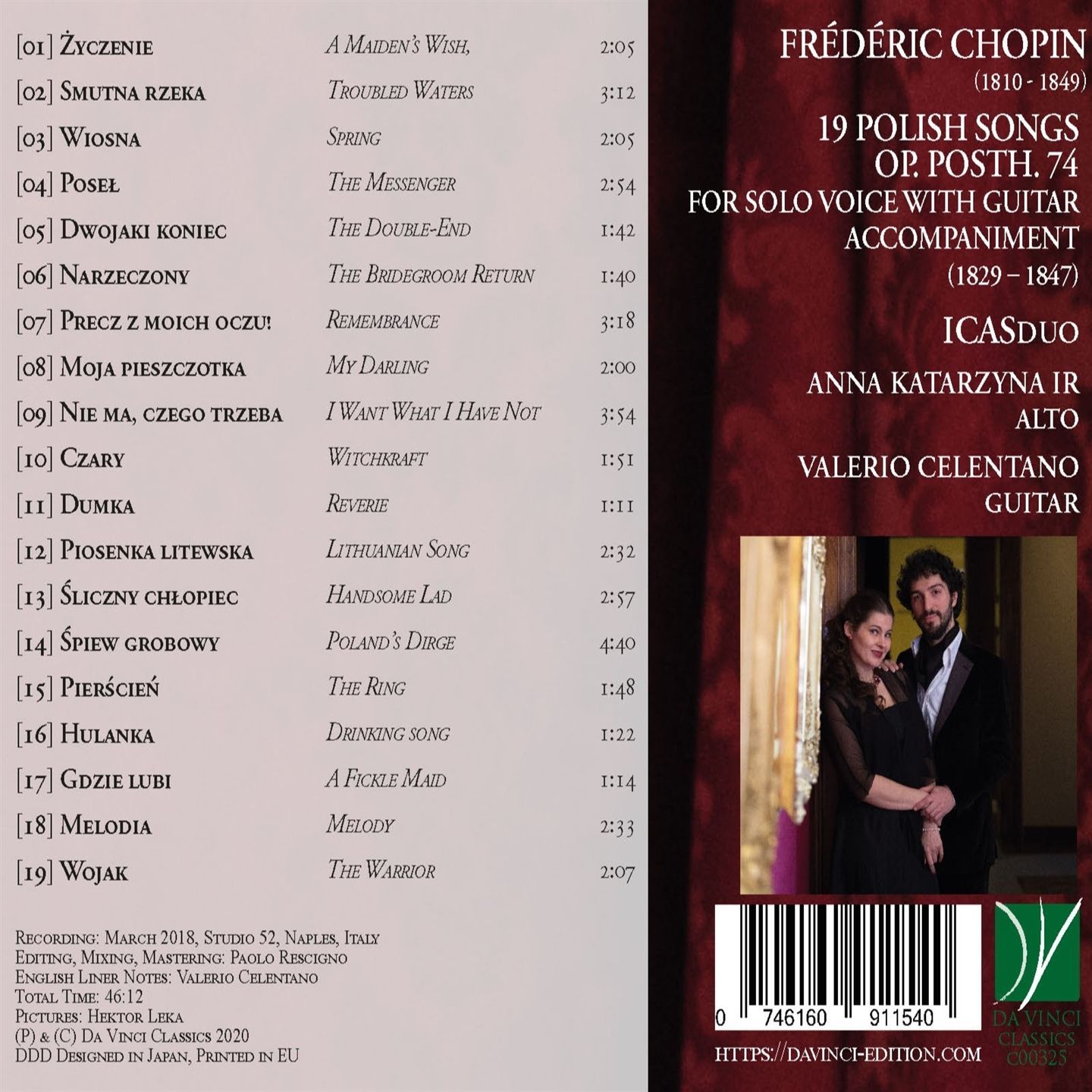
Chopin: 19 Polish Songs Op. Posth. 74, For Solo Voice With Guitar Accompainiment – Icas Duo
Icas Duo
15,90€
Only logged in customers who have purchased this product may leave a review.
Reviews
There are no reviews yet.