




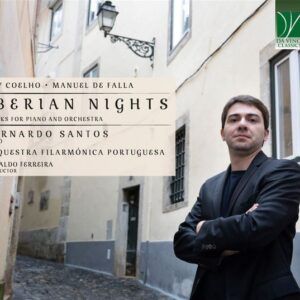
This Da Vinci Classics album is a pioneering project, presenting hitherto unrecorded works by three lesser-known composers. The common trait shared by Charles Doisy (?-1807), Giacomo Merchi (1730-1789) and Antoine de Lhoyer (1768-1852) is the fact that at least a part of their musical activity took place in France. The works recorded here were selected by the recording artists, Duo Noli-Soattin, after long and thorough archival research: this resulted in the choice of a series of original duets for two guitars with five single strings. These works were found at the Bibliothéque National de France, Det Kongelige Bibliotek (Denmark) and at the Københavns Universitetsbibliotek (Denmark).
This research is part of the Duo’s core activity, inspired by a constant study of historically informed performance and with a particular focus on the original repertoire for two guitars between seventeenth and eighteenth century. This was a crucial time for the development of the instrument and of its notation, as well as of its technique. While the typically Baroque guitar was characterized by five double courses of strings and gut frets, the mid-eighteenth-century guitar favoured single strings over double courses, while still later a sixth string – typical for the “Romantic” guitar – came to be used. Moreover, during this period, guitar works started to be written in mensural notation, whereas previously tablatures had been employed (similar to what happened with the lute, theorbo and Baroque guitar).
The novelty of the present recording consists therefore both in the repertoire and in the performing practice. The style galante repertoire for two guitars has not been hitherto recorded following historically informed practice criteria and employing original instruments. This recording is all the more needed, precisely by virtue of the crucial importance of this particular period within the framework of the instrument’s evolution.
For this purpose, two original instruments have been employed in this recording. Both are French instruments, with five single strings; both are owned by the Collezione Accornero, which kindly put them at the recording artists’ disposal. In detail, these two guitars were both made in Paris, one by Ory in 1795 ca., and one by Lambért in 1770 ca. This recording project has been very generously supported by “Adopt a Musician” by MusicMasterpieces (CH).
The exceptionality of this opportunity will become clearer once one considers that only three other original guitars with five single strings have survived until present day. Two of these belong in the Collezione Accornero (“Fabricatore, Napoli 1792” and “Guadagnini, Torino 1794”), whilst the third (“Fabricatore, Napoli 1803”) is in the holdings of the Kunsthistorisches Museum in Vienna. Historic gut strings were employed for this recording: they were designed according to scholarly criteria and kindly offered by Toro Strings Eurostylgut. The recording artists are in fact “Toro String Artists” since 2019. For this recording, the guitars were tuned at 432 Hz. The recording took place in a coeval theatre (1786), which belongs in the Royal Palace of the “Villa Duchessa di Galliera” in Genoa; the theatre’s natural acoustics was maintained in the finalized recording, with no added digital effects, equalization or sound compression.
This is all in perfect accord with the recorded repertoire, whose chronology encompasses approximately six decades – from the late 1750s to the 1800s. During this time, an evolution in instrument-building was found in Italy, France and Germany, leading ultimately to the development of the typical nineteenth-century guitar. The final years of the eighteenth century were politically “revolutionary”, with the French Revolution upturning the establishment and the values of the European civilization. (And the lives of the three composers whose works are recorded here were all affected, albeit differently, by these political changes). But these years were also revolutionary for the guitar. In France and in Italy the new model of guitar with five single strings was developed in these years; the sixth string would be added later. In Spain, by way of contrast, a sixth lower string (the low E) was added to the five double courses of the Baroque guitar, and only later the double courses were reduced to single strings. Even though these national features were crucial, it should also be remembered that these guitars were very “mobile”, and that instruments traveled frequently among the European countries.
The notational revolution, with the transition from tablatures to mensural notation, happened in parallel with these structural revolutions. The notational change is ascribed to Giacomo Merchi, who, in his 1761 treatise called Le guide des écoliers de guitar, described and employed the new mensural notation as well as the performance technique for guitars with five single strings. The works recorded here were published some years earlier, in 1757, but they already display the main features of Merchi’s style.
Indeed, the figure of Giacomo Merchi is almost inextricably intertwined with that of his brother, Giuseppe Bernardo, who was in turn a composer and guitarist. Even some of their biographical data are difficult to ascribe with precision to one or the other of the two siblings, whilst many of their published works are printed under their family name, without specification of authorship. In 1751, the two siblings performed in Rennes playing many different plucked-string instruments; on that occasion, they were also credited with the invention of a new instrument, called colascioncino; however, this could actually be the (already known) Neapolitan “colascione”. In 1753, the siblings performed at the Concerts spirituels in Paris; both were playing the colascione. Paris welcomed them, allowing them to teach, publish (with a publishing privilege) and composing, while also writing guitar treatises. Their works bear witness to the previously described evolution; for example, in their op. VII the statement is found that “those who know only tablatures will play and accompany only routinely and without measure”. Even when the guitar is employed merely as an accompaniment to singing, for Merchi, in conformity with Enlightenment ideals as expressed by J. J. Rousseau, the guitarist should sustain the melodic line gracefully and with understanding.
Among the pieces recorded here, the First Duet, with its Caccia (the Hunting), is particularly significant. Here, we find a suggestive imitation of hunting horns: this reveals an “orchestral” concept of the guitar, to which the performing artists’ interpretation adheres. The works by the Merchi siblings thus proved inspirational for other teachers such as Corrette (1762) and Alberti (1786).
The activities of teaching, composition and publishing were also practised by Charles Doisy, about whose life little is known. His oeuvre consists mainly of duets, whereby the guitar accompanies instruments such as the violin, oboe, clarinet, bassoon, flute or cello – or else, of course, another guitar. Similar to the Merchi siblings, Doisy wrote a treatise (Principes généraux de la guitare) dedicated to Napoleon Bonaparte. In this work, he expresses his preference for the single strings, but he also bears witness to the transitional nature of this period: “Some favour double choirs, while others single strings. […] Ordinarily five strings are employed. […] As concerns myself, I preferably use single strings since they produce purer sounds. It is very difficult to find properly tuned strings, and single strings need less time to be tuned”. Moreover, he added: “My reflections, although not binding, are in praise of the guitar with ten frets and five strings. In spite of its modest simplicity, it can touch the soul when one knows how to caress it”. Among Doisy’s many works is one of the earliest Concertos for guitar and orchestra, as well as facilitated arrangements conceived for amateurs, or miscellanies on themes by Haydn and Mozart.
If Doisy’s treatise was dedicated to Bonaparte, the life of Antoine de Lhoyer was also deeply marked by the events of the French Revolution. A former student of Porro, a famous master who taught five-stringed guitar, de Lhoyer served in the Gardes du Corps du Roi. He escaped the guillotine but had to flee France during the revolutionary years. After fighting against the Jacobins, he found refuge in many European countries, residing in Hamburg (where he published his op. 12-18), in St Petersburg (where he taught the Czar’s daughters and Czarina Elizabeta Alexeevna, and where he collected many Russian tunes, publishing his op. 19-27), and eventually returning to France after Napoleon’s fall.
The waltzes recorded here, called “Valse et trio”, date from the St Petersburg period, and are typical for de Lhoyer’s output; they also represent faithfully the kind of musical pastimes of the nobility. In these years, the guitar is frequently depicted in the fashion journals, embodying an “accessory” usually found in the hands of charming young ladies.
These works are true musical gems, expressing the aesthetic ideals of the composers and opening up fresh insights onto a crucial (but delightful) moment in the development of the guitar and of its repertoire.

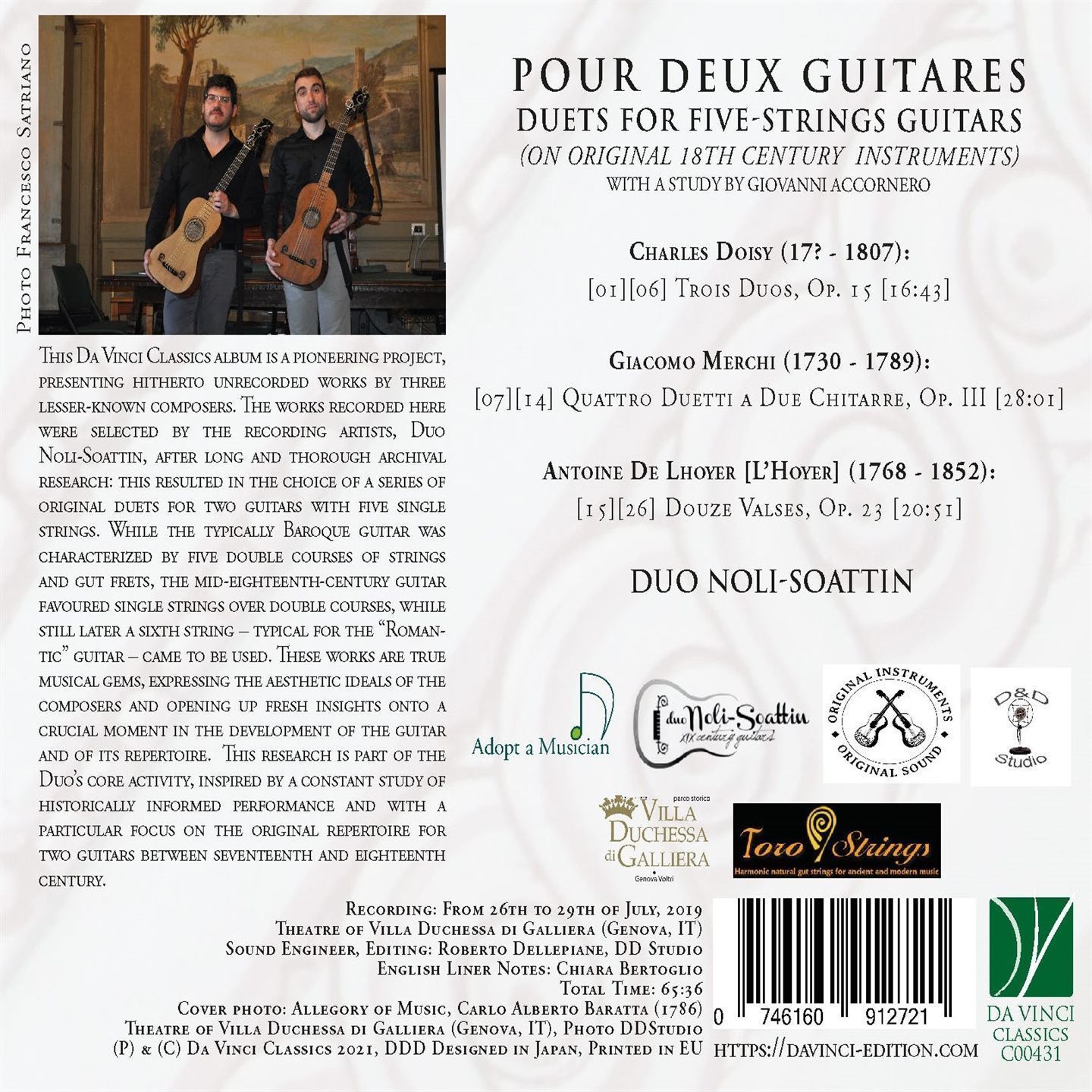
Doisy / Merchi / De Lhoyer: Pour Deux Guitares, Duets For Five-Strings Guitars – Duo Noli-Soattin
Duo Noli-Soattin
15,90€
Only logged in customers who have purchased this product may leave a review.
Reviews
There are no reviews yet.