




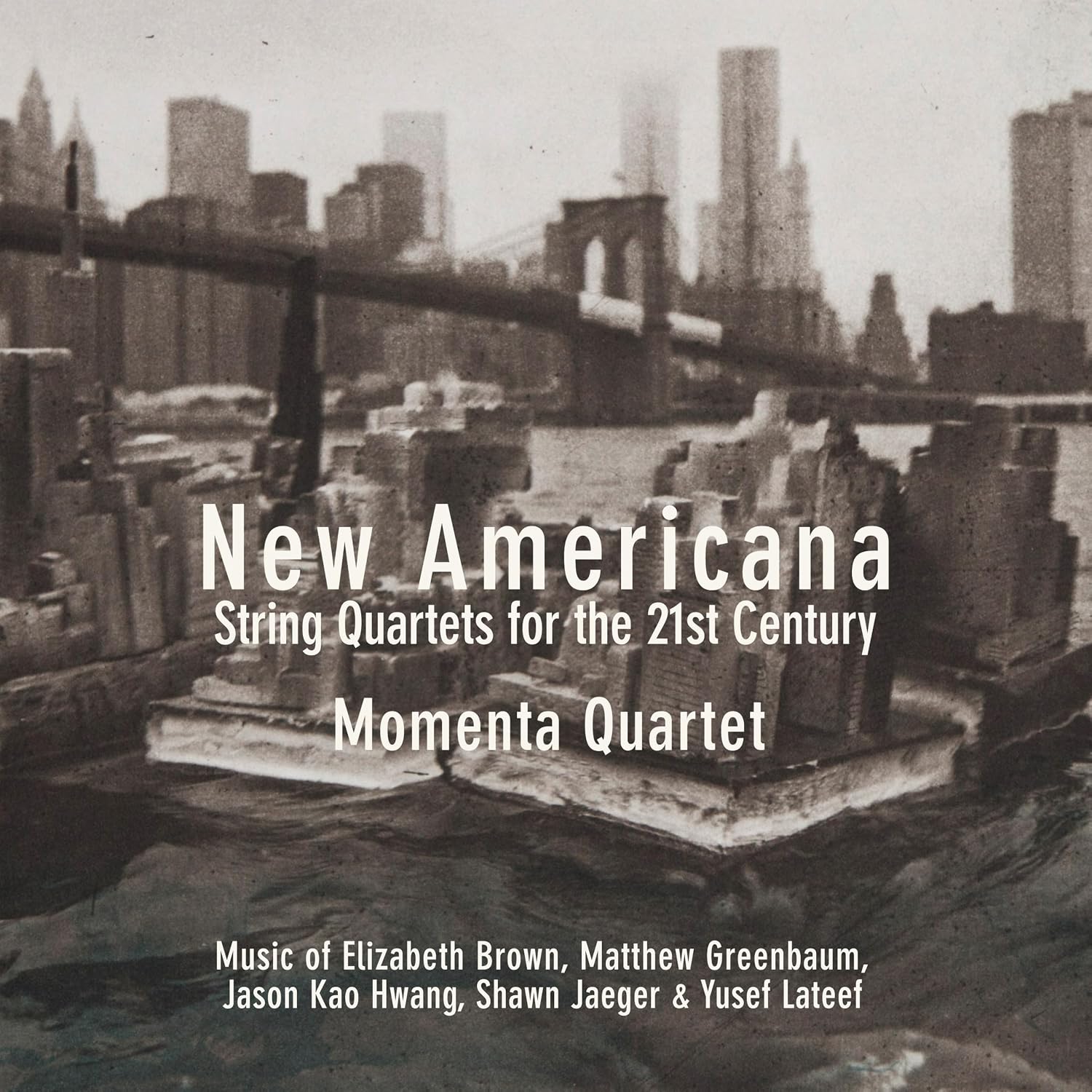

The present recording celebrates the staggering variety of the American string quartet in the 21st century. All but one of the five works was given its first performance by the Momenta Quartet, a group which since its founding nearly 22 years ago has proven itself equally comfortable with modernist complexity, neoromanticism, postminimalism, microtonality, and music with indeterminate and/or improvisatory elements. Echoes of all these aesthetics surface here, but each composer has carved out an individual voice that transcends easy categorization, which is a hallmark of these times.
Like most of the music of Shawn Jaeger (b. 1985), Thy Wondering Eyes (2010) takes its inspiration from folk music traditions of the American South; in particular, the quartet evokes the hymn singing of Old Regular Baptists of central Appalachia. The most unabashedly tonal work here, Elizabeth Brown’s (b. 1953) Just Visible in the Distance (2013) is subdivided into ten small movements which are collected into two larger, roughly equally sized portions, which Brown calls “sections,” each played continuously without pause.
Jason Kao Hwang’s (b. 1957) If We Live in Forgetfulness, We Die in a Dream (2011) is his first fully notated work for string quartet and it is informed by a lifetime of improvising on the violin and composing for other improvisers. It is an exciting sonic journey with abrupt shifts from yearning solos to eerie slides to propulsive contrapuntal passages. String Quartet No. 3 (2013) was Yusef Lateef’s (1920–2013) very last composition and, like the canonical works of European classical and romantic composers as well as its predecessor (No. 2), it is parsed in four movements of roughly equal duration with no descriptions beyond tempo indications.
As its title implies, Matthew Greenbaum’s (b. 1950) More Venerable Canons (2013) is something of a sequel to his four-movement 2007 flute and violin duo Venerable Canons, in which melodic shards shift mercurially between the players. For More Venerable Canons, since a quartet contains twice as many players, each of whom is independently capable of polyphony, Greenbaum ups the ante and each of its six brief movements spins counterpoint from rotational iteration, often resulting in very dense counterpoint.
Reviews
There are no reviews yet.