



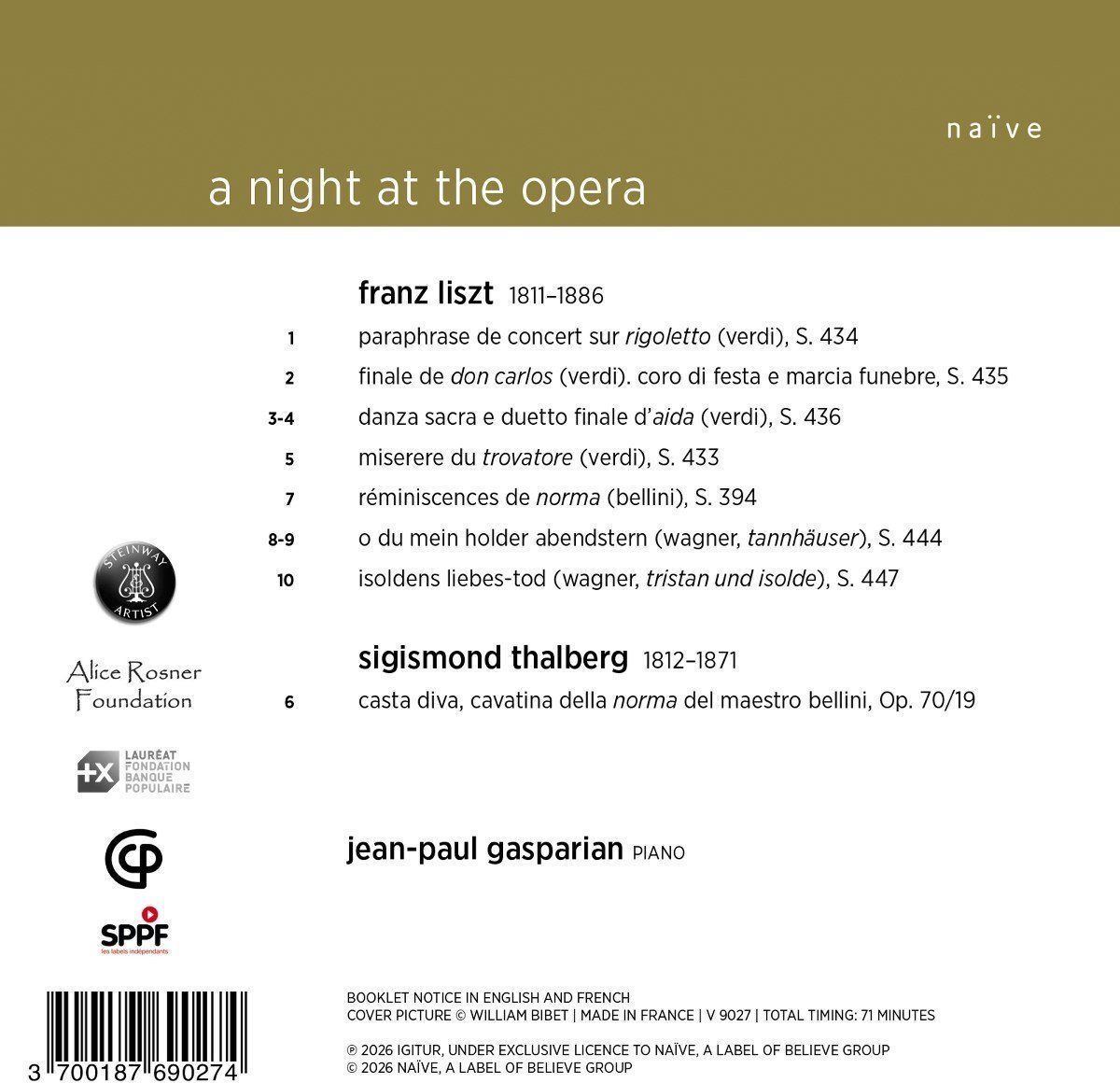
For his third album on Naïve, French pianist Jean-Paul Gasparian returns to the roots of his tempestuous, dazzling, exalted, and romantic playing throughout an intoxicating recital composed of paraphrases and transcriptions that Liszt created from themes by Verdi, Bellini, and Wagner.
By borrowing the title of one of the Marx Brothers’ most memorable and zany films (released in 1935 and directed by Sam Wood) for his third Naïve album (following DEBUSSY V7958 in 2023 and ORIGINS V8444 in 2024), Jean-Paul Gasparian sets the scene. Rest assured, he will never crack nor collapse, so dazzling is the technical mastery of the French pianist throughout. Here, the keyboard crackles with a thousand fires; fingers take flight like little devils that will long haunt your dreams across this recital structured around the paraphrases and transcriptions that Franz Liszt crafted from themes and motifs by Verdi (Rigoletto, Don Carlos, Aida, Il Trovatore), Bellini (Norma), or Wagner (Tannhäuser, Tristan und Isolde).
In the grandiose Miserere from “Il Trovatore”—a virtual gateway placed halfway through his recital—the French pianist deploys all the mysteries of his dark and tragic piano, rendered even more intense in the Réminiscences de “Norma,” a score of fantastic dramatic power and another clear triumph for Liszt in the paraphrase genre. What a vision here! As if memories resurfaced, vehement, in the course of a monstrous waking dream. Jean-Paul Gasparian effortlessly carries all these prodigious frescoes that established the triumph of the pianist-king in the mid-19th century.
For Liszt, the paraphrase represented an act of love—toward the people (opera being the popular art form par excellence) and toward the composers whose formidable creative genius he promoted and subsequently glorified through his art of improvisation. From 1829 (Grande fantaisie sur “La Fiancée,” after Auber) to 1882 (Réminiscences de Boccanegra), the Hungarian Romantic engaged with some thirty composers, creating a catalog of about sixty scores dominated by Bellini, Donizetti, Meyerbeer, Mozart, Verdi (nine times), and of course Wagner (fourteen times!). In doing so, he helped pioneer a new era for the piano.
By confronting these great Lisztian recreations—and Thalberg’s brief, serene revision of Casta diva—the French pianist, just turning thirty, returns to the roots of his tempestuous, dazzling, exalted, and romantic playing, in which brilliance and poetic depth blend exquisitely. No, your night will most certainly not be restful!
Jean-Paul Gasparian (piano)
Avis
Il n’y a pas encore d’avis.