




Italy: a country of poets. Here they are expressing themselves in their living artistic creativity (A. Mei, A. Ottobre), or they may have been already celebrated by history (U. Saba, S. Quasimodo, F. Petrarca).
Italy: a country of saints. Here they are present in the texts of the Catholic liturgy, or, more secularly, they are represented by the sensitive souls of musicians who are moved by a sincere spirituality.
Italy: a country of sailors. “Musical sailors” who move among various musical genres and instrumental combinations (the output of each of the composers presented here ranges from vocal to instrumental music, comprising the most diverse kinds of ensembles). Here they are united by contemporary musical languages (in spite of their great variety), by refined and evocative lyrics and by generational affinities; at the same time they are separated in time and space, from Rome to Padua, from Milan to Cuneo, with works written approximately in the last quarter of a century. Here, in this CD, we offer a glimpse on the choral world of contemporary Italy, without claiming to be representative.
The CD germinates from a strong poetical-musical nucleus which fascinated us during the last few years. Firstly the human being is at the heart of the poetical subjects of these pieces; then there is the topic of singing, be it joyful or praising, introspective or pleading; the human voice is the “energetical centre”, a festive circular rondeau: «Quando canto, sì, io canto!» (“When I sing, yes, I sing!”).
Different kinds of sensitivity shed diffrent lights on love, on wishes, on the destiny of humankind, on the meaning of existence, on the desire for salvation, on the need for devotion and sacredness, on the mystery of Incarnation; at times with a vivid mystical ardour, at times with pious religiosity; here with a fairy-tale or visionary tone, there with a sad disenchantment, with a paradoxical ardour or with a loving tenderness. Similarly varied are the compositional techniques, producing results which can be sweetly harmonious, pointillistic, or evocative of jazz sounds, or which can remind us of cinematographic expansions, here developing as a great arch, there multiplying themselves in iridescent and varied harmonic turns.
This glimpse on the choral languages of modern Italy, made of intense lyrics, set to music with knowledgeable mastery by some important Italian composers, blossoms from our relationships with several musicians, from our personal research and from a dialogue with the audience.
Finally, this CD is an outlet for our wish to present a recording of Sergio Sentinelli’s vocal works, represented here by his most important compositions (the only missing pieces are those still waiting to be revised by the composer). Sentinelli’s pieces are mostly homophonic, with the notable exception of «Scivolando sui muri…», which is a kind of a modern madrigal, full of sparkling and irresistible rhythmical liveliness. His works seem to investigate the possibilities of the harmonic colours, in a process of accumulation which – particularly in the latest works – led him to favour multi-voiced compositions (eight parts in the most recent pieces). «Quando canto» is paradigmatic from this viewpoint: from a minimal and “circular” text (“Quando canto, sì, io canto”) Sentinelli creates an iridescent palette, expresses an infectious vital energy, employing dense and varied harmonies, and concludes the piece with a chord incorporating both the major and the minor third. That chord had already made a passing appearance in «The Waning Moon», a piece efficaciously describing the moon’s swaying through suspended and rocking harmonies. The pictorial skills displayed in «Nel Cielo» through the coloristic use of harmonies is accompanied, there, by imitative episodes and layers with different lyrics; these strategies allow the composer to sustain a wide-ranging work, developing a musical narrative in four sections, each having marked features of its own. The note clashes found in the female piece «Praesentia corporis» seem to have a diffrent role: not so much blocks of extended harmonies, but rather dissonances, true contacts of sound mirroring the lyrics’ complexity and their relevance to the senses and corporality of the Christ. The Father’s benevolent gaze, sought by those reciting the Prayer of the Lord, is expressed in the «Pater noster» by Sentinelli through the use of a four-part mixed choir, frequently enriched by sections in eight parts, for a heartfelt and serene music.
A slightly more extensive comment is reserved for «Riuscirà la nostra voce», the piece which gave birth, years ago, to our relationship with Sergio Sentinelli.
In the original score there are no dynamic or agogic indications; the musical time ows as in a declamation; imitations are entirely missing, and the tune is “plain”, with the exception of a short élan by the First Sopranos. In spite of this, the piece intensity immediately surfaces, expressed by other means. Sentinelli paints the lyrics’ phrases and words through varied harmonic hints: at times darkening the harmony in the lower pitches, at times by thickening the internal texture, at times (just once) with a shining outburst of the soprano reaching high pitches (“Finché le notti d’estate continueranno a udire il canto”, «Until the summer nights continue to hear the song»). The conclusion is an atypical “da capo”; basically, it is a reprise of the initial harmony and rhythm, sealing the piece with a feeling of circularity. It is as if the panting and disquieting lyrics, with their stabbing questions, were to be framed by a dreamlike dimension – where each realization becomes possible – rather than in a historical dimension which is unavoidably condemned to realism. The Ensemble del Giglio performed this piece premiere in January 2012; the same piece was later selected, the same year, by Gary Graden for the international festival Europa Cantat in Turin.
Bruno Bettinelli has frequently been nicknamed “the masters’ master”, because he educated numerous generations of musicians. Since we wished to insert some of his works in this CD, our choice fell on three aphorism-like pieces; in spite of their brevity, they represent the typical musical tension which the Maestro was capable of creating. There is a progressive expressive arrow, a harmonic accumulation, a dynamic amplification; I would like to define it as a “bettinellian crescendo”, which is found also in other of his sacred works (e.g. the first part of his celebrated «Aurora»). Bettinelli’s prolific and varied output has also led us to go beyond our original concept of the singing forces in this CD: thus, we are offering a glimpse on two solo instrumental works, in the belief that his ability to master the expressive peculiarities, the idiomatic language of diffrent instruments (be it a clarinet, an accordion or a choir), all of this can cohabit in the same composer’s art, and, in those who are most gifted, all of this is intertwined and reciprocally enriching.
The near-atonality of some of Bettinelli’s vocal works is found, therefore, and mutatis mutandis, in these two instrumental works which are, respectively, for the solo clarinet and solo accordion. They are written on the twelve tones, with the serial technique, and they exemplify the numerous techniques which Bettinelli could master, going from the neoclassicism to dodecaphony, and up to a personal harmonic language with an enlarged concept of tonality. The «Improvviso per fisarmonica da concerto» is recorded here in its world premiere.
From the harmony which had disintegrated itself into the serialism of the «Studio da concerto per clarinetto in sib», the CD moves to the broken words of the «Benedicite Dominum» by Gianluca Verlingieri. They may be an icon of the disorientation one experiences when facing the mystery of the Divine, from which one can receive some consolation only within a personal relationship: this happens when the singing ceases to be shattered in individual syllables and becomes the tranquil and plain tune of the Soli. This newly-found force becomes, in the second part (“Sancte Michael Archangele”) a pleading request, an imploration for salvation, with deeply touching dynamic contrasts and emotional accelerations.
The «Trittico italiano» by Alessandro Kirschner is, at the same time, both articulated and clearly unified. The lyrics walk on the razor’s edge of the paradox and are hinged on the dualism between joy and pain, with sudden changes of mood; the music mirrors this development with a diatonic and tonal language, with chiseled imitative fragments, with gradual dynamic modulations and sudden sound lacerations. The triptych begins and ends with two pieces having a similar harmonic language; the central section is made of new and more luminous sonorities, and plunges into the low register only when the lyrics mention death; later, it soars once more in the higher register, sustained by love’s breezes. Due to its performing forces, «Benedetto sia ‘l giorno» (for choir, clarinet and accordion) is the natural seal of this CD: written for this occasion, it is dedicated to «Ensemble del Giglio». In this passionate piece, each of Petrarca’s stanzas corresponds to a musical section, each of which is separated by an instrumental intervention; the writing is somewhat reminiscent of that of the ancient madrigals, and, in our performance, also the instruments join in this language and in its distinctive phrasings, with messa di voce and melodic arches through which music is put in the service of the sung words.
In this album, along with the sacred works, only two pieces are set to lyrics of poets who no longer live: «The Waning Moon», on lyrics by Percy B. Shelley, and «Benedetto sia ‘l giorno», on lyrics of the great Francesco Petrarca: this is also the CD’s last piece, as if it would conclude the itinerary by returning where it all began, with one of the fathers of the Italian language.
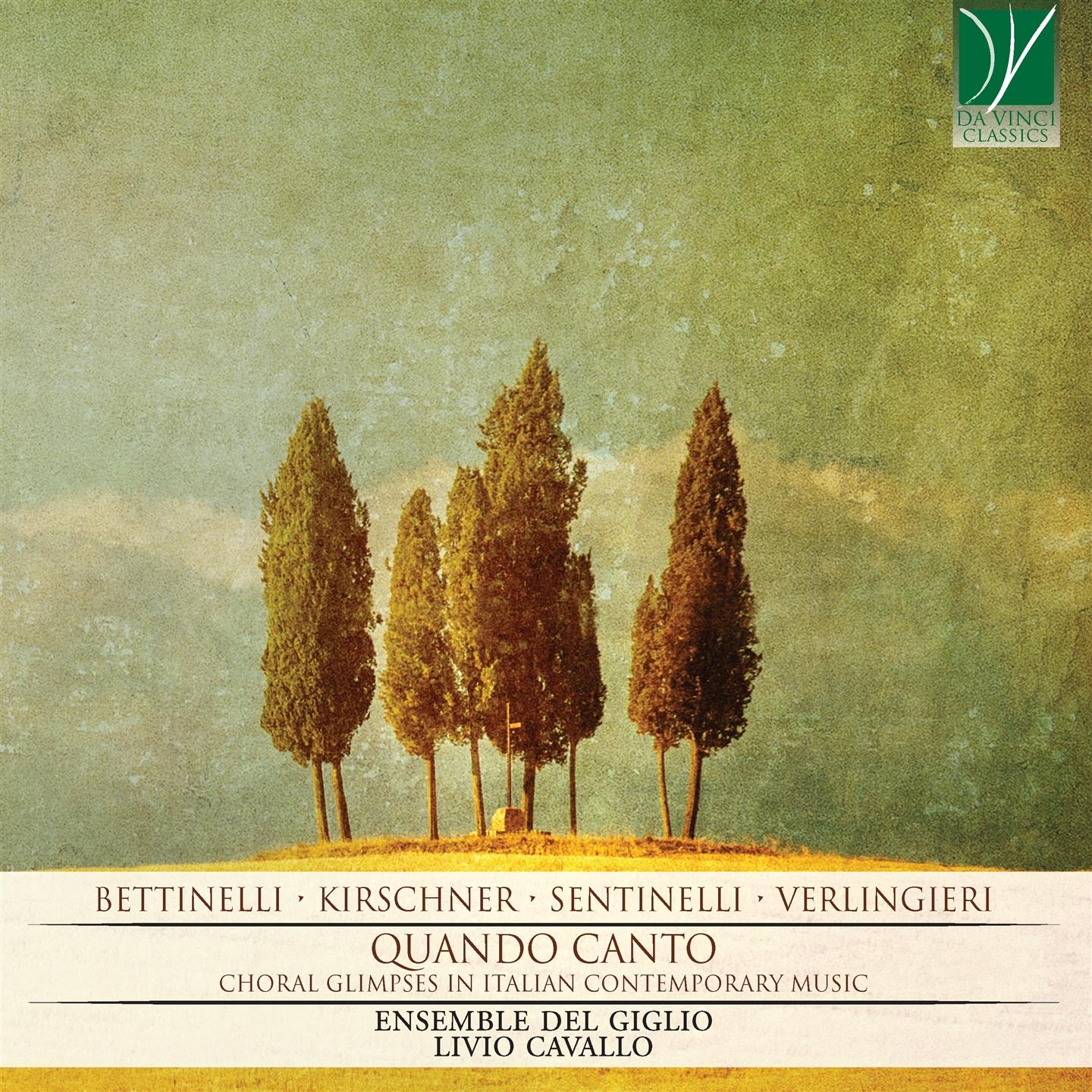
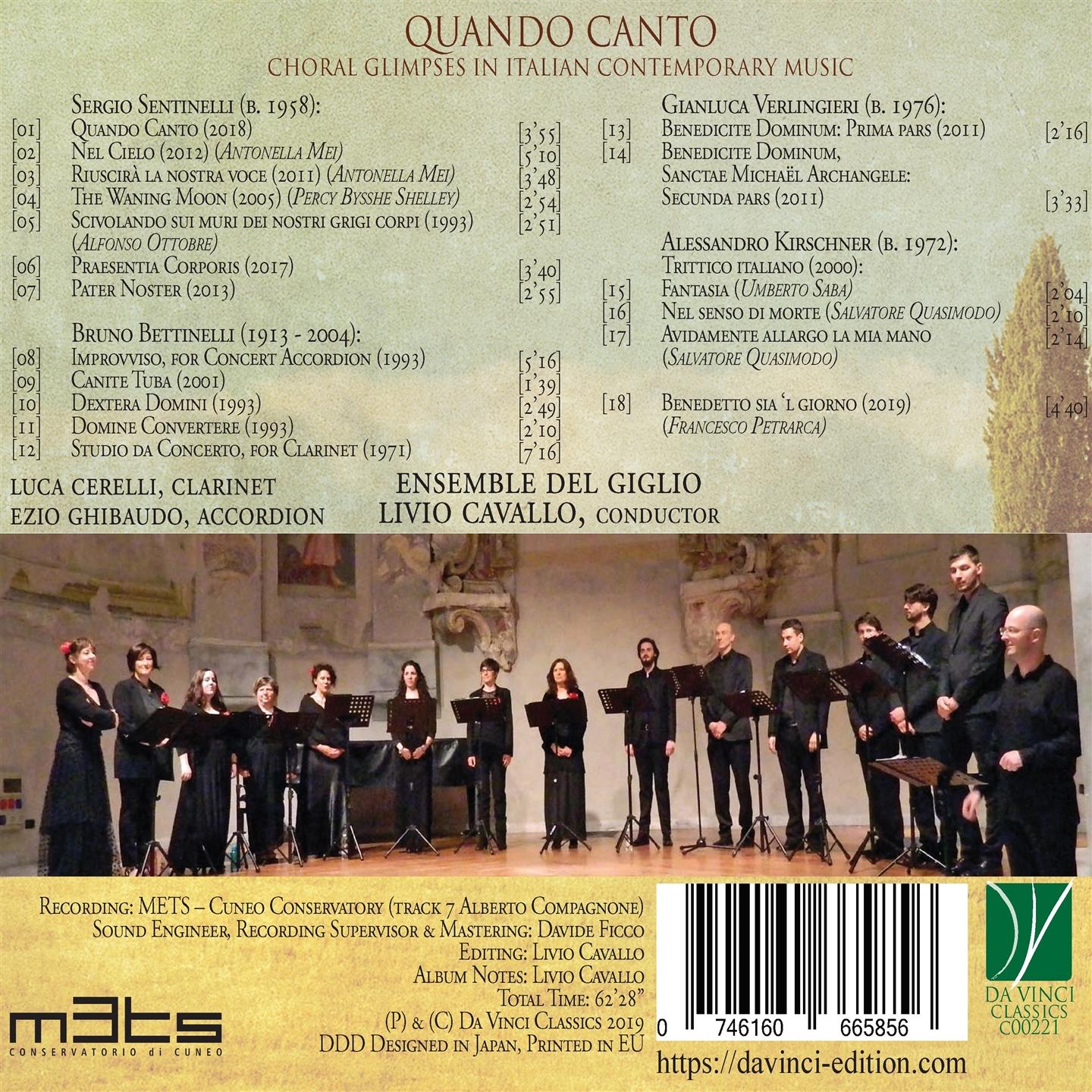
Quando Canto: Choral Glimpses In Italian Contemporary Music – Ensemble Del Giglio / Cavallo
Ensemble Del Giglio / Cavallo, Livio
15,90€
Seuls les clients connectés ayant acheté ce produit ont la possibilité de laisser un avis.
Avis
Il n’y a pas encore d’avis.