


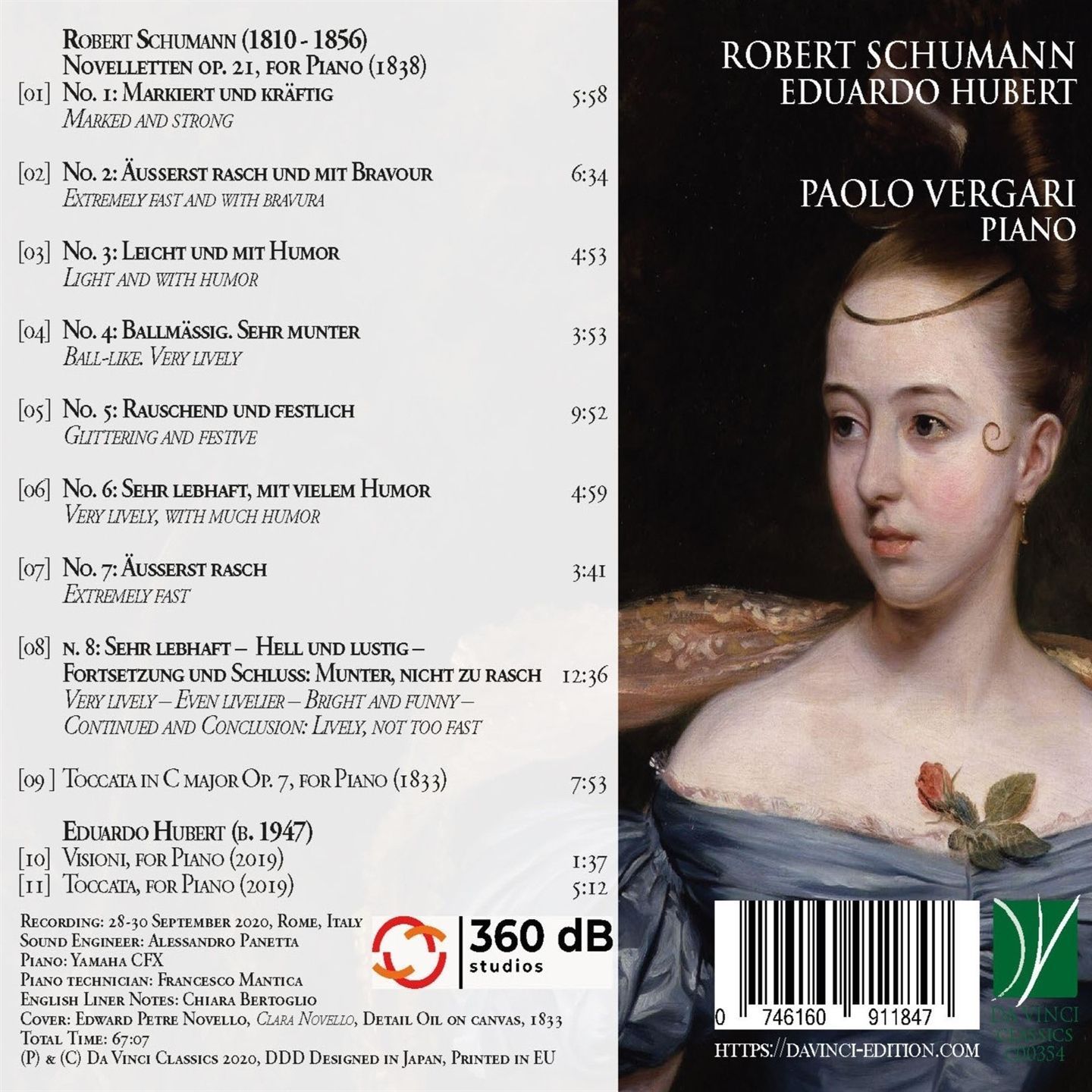
s a young musician, Robert Schumann had focused his attention on the piano for a long time. He had had the ambition of making a career as a solo concert pianist, a virtuoso who played his own works as was customary at the time. This focused interest is demonstrated by the long list of his first published opus numbers, in which the piano is the undisputed protagonist. The image of the young virtuoso pianist, however, should not mislead us into thinking that Schumann was obsessed by the piano to the point of neglecting other interests: as is well known, Schumann was a keen reader and a promising writer himself (and this, along with music, was his primary artistic interest), but he was also a law student (in this case, not due to a special interest of his own but rather to his family’s desires).
If music and literature were Schumann’s artistic passions, his personal life was enlightened by his love for Clara Wieck, who would later become his wife, and who was an extremely gifted pianist and a composer herself (one of his pieces is elegantly cited in one of the Novelletten recorded here). It is understandable, therefore, that on numerous occasions Schumann sought to unify these pillars of his creative and sentimental life, through the realization of musical works with a literary inspiration, a pronounced virtuoso character, and a more or less hidden dedication to his bride-to-be.
Clara, who was nine years his junior, had been educated by her father (who was also Robert Schumann’s mentor and teacher) who had developed his daughter’s musical and technical skills to an almost prodigious level. Her technique was extremely brilliant and dazzling, and one of the works which had contributed to this result was a Toccata by Carl Czerny. While Czerny is not remembered today for the lyricism and beauty of his compositions, his works are still widely used in piano pedagogy as exercises and etudes. Czerny had been a student of Beethoven, and had realized an instructive edition of Bach’s Well-Tempered Clavier which would become one of the most influential sources of inspiration for the interpretation of Bach on the keyboard in the following decades. This edition, according to Czerny’s claims, did not transmit his own idea of how Bach’s works should be played, but rather it did preserve Beethoven’s interpretation of Bach.
Indeed, Toccatas as a musical genre belonged more to Bach’s era than to Beethoven’s, Czerny’s or Schumann’s; they were a form typical for the early and late Baroque era, and had become a paradigm for a keyboard piece with an intense technical complexity, and which might adopt a recurring pattern. Like most technical exercises, in fact, a difficulty is overcome by repeating it – and is heightened by the same repetition, which may lead to fatigue and tiredness.
Schumann was a devoted admirer of both Bach and Beethoven; and though probably he was not as enthusiastic of Czerny, the fact that his beloved Clara had spent so many hours on Czerny’s Toccata might endear even this rather arid piano piece to the young lover.
Thus, Schumann’s own Toccata op. 7 represents a homage to Clara, to Czerny, to the Baroque era and to piano technique. Actually, the first draft of the Toccata was titled Exercice, and later he renamed it Etude fantastique en double-sons (Fantastic Study in Double Notes). The dimension of “exercise” is doubtless evident; Schumann himself considered this piece as the “hardest ever written”, and the claim was fully justified at the time of its composition.
However, the retrospective element of a reminiscence of the Baroque era is no less evident. Schumann in fact added a footnote to the first edition of this piece, stating: “In order to leave the performer as much latitude for the expression of the music as he feels it, markings are indicated only in those places where the performing technique makes heavy demands upon the player”. The piece’s visual appearance in print has in fact little more than the “bare notes”, and eschews the numerous indications for expression and dynamics which are found in most Romantic piano works. Schumann thus considered the “clean” appearance of Baroque musical scores as an unexplored field in which the performer’s fantasy could have free rein.

Alleen ingelogde klanten die dit product hebben gekocht, kunnen een beoordeling achterlaten.
Beoordelingen
Er zijn nog geen beoordelingen.