


“Parfums Nocturnes”, conceived out of dreamlike textures, form a cycle of compositions for solo guitar, both informal and intimate, soberly sculpted in time. The different pieces, like scents that evaporate into top, heart or bottom notes, come together in a vast Fragrance of sound, in a constant dialogue between composer, improviser and performer, seeking in turn unity amidst long echoes turning in the evening air. The composer lives in a world of volatile ideas, indicates the artistic direction driven by exigency, is passionate about the evolution of music writing, filled with admiration for his predecessors. For how can one compose without knowing the more than thousand-year-old lineage of Western music, how can one not draw from it? However, the improviser totally questions any form of perfectionism, knowing how to take advantage of the present moment to transform a false note into a true emotion: perhaps all has not yet been said? Fortunately, the performer, the basis, gives body to the other two, makes their thought become incarnate in the tone, thanks to his inseparable relationship to the instrument. The first composes for the last, the second brings the taste for risk, that flayed emotion that makes the audience applaud in the middle of the piece. The complementary relationship between these three characters involved in the creation becomes more complex when they are part of the same consciousness, as the roles are easily reversed when, for example, the composer writes the score only after the improviser and the performer have finished recording it. But we also find the same ternary structure of the perfume in the diversity of the echo of the winds that cross the cycle of “Parfums Nocturnes”. The burning breath of the sirocco brings the Andalusian rhythm, it is indisputably the heart note of our fragrance. The top note undoubtedly lies in Western polyphony. The blue note being perhaps here this bottom note… “Chemins de traverse” (Allegro misterioso) or the city with the mountain in the centre, “Fleuve de l’oubli” (Allegro capriccioso) or the soluble whims, and above all “Clair-obscur” (Largo con tenerezza) contain underlying swing. Chopin’s last Nocturnes already foreshadowed the Impressionism of Debussy and Ravel, and we are familiar with their common taste for enriching learned music with popular tunes and rhythms. The first draws from Polish folklore, the other two from Spanish music or jazz, passing the torch to national composers such as de Falla or Bernstein. As ideas circulate, the modal language thus enriched will obviously return to the sources, in turn enriching them with an extremely refined harmony, and one will find fourth chords in Bill Evans or Paco de Lucia. These cultural exchanges will become so constant that it will be rather usual to find these three currents together in a classical guitarist’s programme. “Dialogues de Saphir” (Largo appassionato) and “Echos des vents” (Rubato con grazia), both composed on piano, have that romantic resonance of cyclones in a cup of tea. It is difficult to escape the bewitching influence of Spain when composing music today: its modality leads us directly to it. Simply impossible if you are a guitarist: the irregular compasses of the Buleria or the Siguiriya are fascinating. If one looks for inspiration in ancient music, like Cervantes plunging into medieval chivalry literature with his Don Quixote, in order to invent the modern novel – one can find a real rhythmic gold mine among pieces like “La perra mora”, an anonymous 15th century piece written in a five-beat metric, with an unsuspected groove before its time. Three pieces have this colour: “Ombres” or the 43°C in the sun (Presto appassionato), “Aurore” (Rubato con grazia), or first impression and “Rubis de champagne” (Allegro con fuoco) or the new bowl of our goldfish. But the renewal of musical languages in the 20th century, both among the Impressionists and the Expressionists, and the resulting formalism, leads us to ask more seriously the almost hidden question of the Content of the work, since it is there that its different elements will truly unite, in order to give cohesion. Whatever the music, it is its emotional charge that matters: this is already true in maternal lullabies when one is a child. This is how the musician and the listener communicate. It is also through this means that the synthesis of the different contributions is possible! The most abstract pieces talk about it: “Rêve d’émeraude” (Rubato narcissico, moderato con anima) or the end of Narcissus, “Une pierre dans l’arbre” (Allegro giocoso) or playful laughter, “Prologue” & “Epilogue”. Questions of expression are certainly not unknown in European classical music, and each composer indicates the character of a piece at the top of the page. The Romantics even invented “programme music”. But formal questions soon took over. It is in Indian classical music that the concept of Rasa (mood), the fleeting moment of grace, leads us to permanent emotion, via suggestion and resonance. Knowing that both ancient and contemporary music, flamenco and jazz use ideas such as circular rhythm, modality, improvisation, all coming straight from this culture, how is it possible that the essential has gone lost? “Danseuse de silence” based on the supposed steps of dance found in prehistoric caves dating back 25,000 years ago, “Eclipse” (Largo quasi erotico) where the night of the day awakens my shadows, and “Poussières d’étoiles ” (Moderato Cantabile) or the twilight of a goddess, go in search of it. Here, every Nocturne is a dream, with its own confused logic, where melodies and rhythms, harmonies and timbres find a right balance, the expression of their stability linking us to each other, and “Maison d’azur” (Allegro furioso) or the reversal of the situation, relates to it. In the darkness, the forms dissipate, even disappear, giving way to the content, to the artistic part of art, extracted like a floral essence: what the Muses whisper and really reveal to us, formal beauty being only ornamental. Two inverted movements run through the entire programme, but also through each piece separately: expression and its opposite dynamism, impression. The first sets body and soul ablaze, provokes catharsis and comes from within. The second soothes the heart and comes from the outside to gently embrace us. Thus the titles of the compositions pose the question of inspiration, of meaning, and the music sketches a possible answer through its cathartic resonance, its moving power in a decisive unison between Apollo and Dionysus, a final resolution, the Coda.
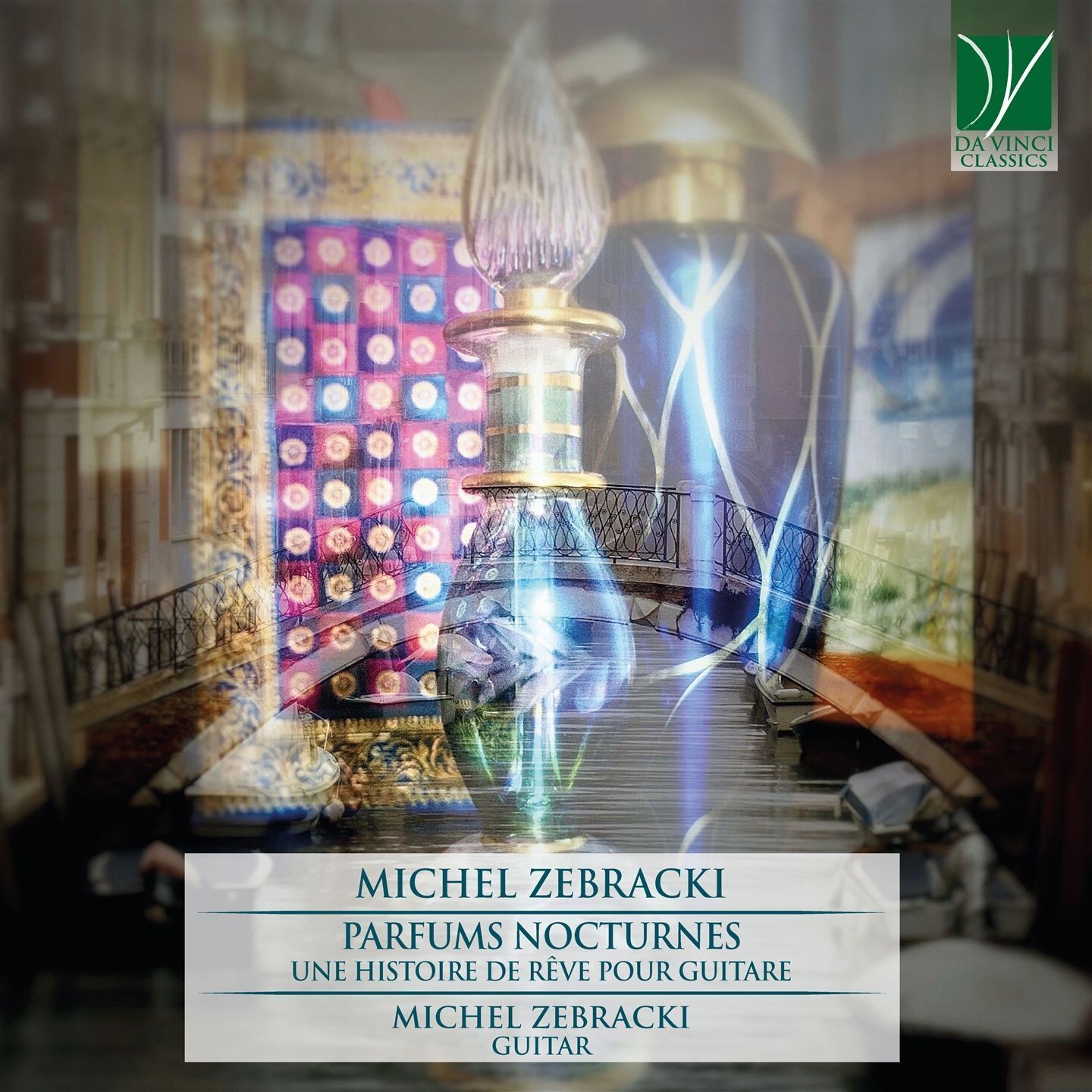
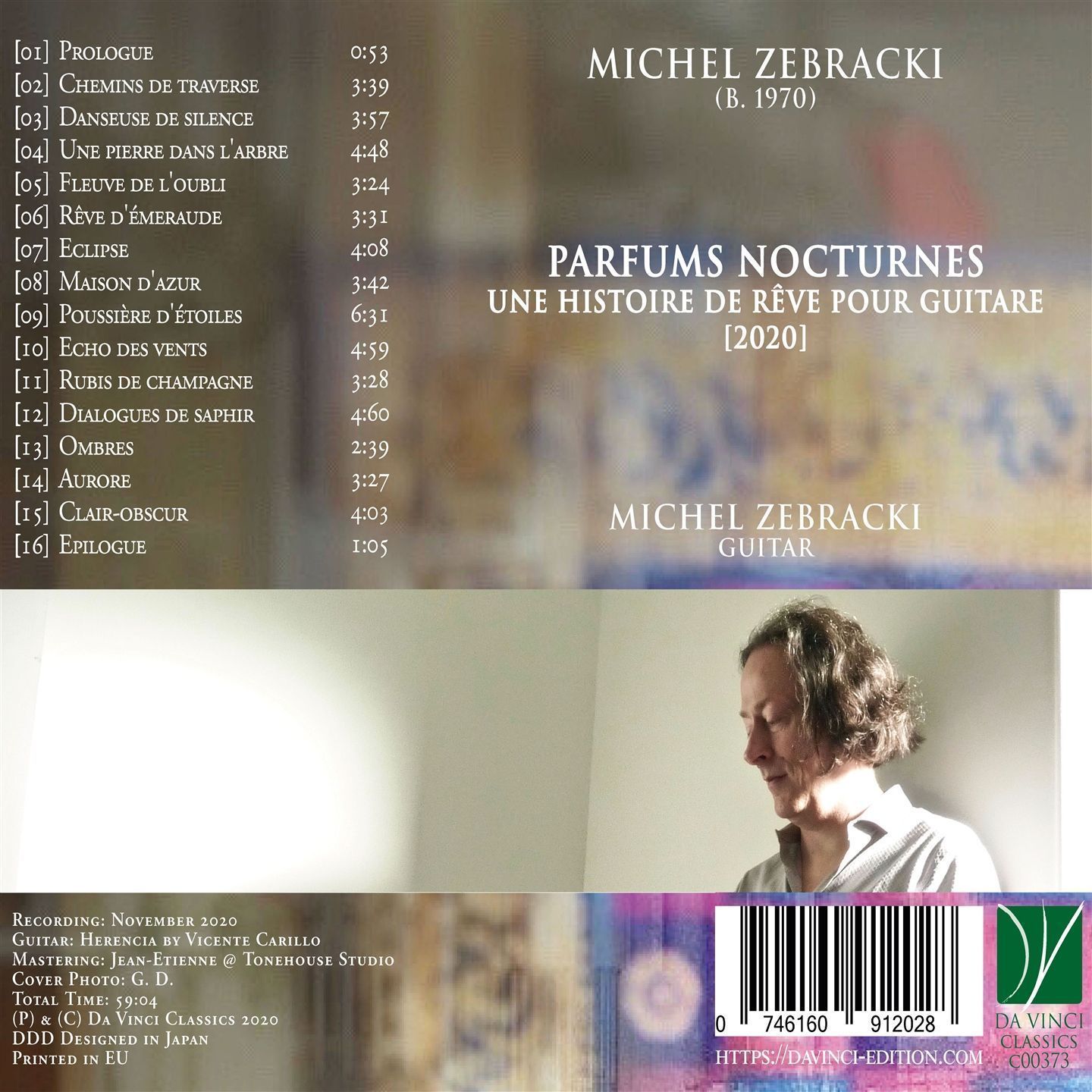
Zebracki: Parfums Nocturnes (Une Histoire De Rêve Pour Guitare) – Michel Zebracki
Michel Zebracki
15,90€
Alleen ingelogde klanten die dit product hebben gekocht, kunnen een beoordeling achterlaten.
Beoordelingen
Er zijn nog geen beoordelingen.